
Developed material
This link provides access to all developed materials. The resources are organised into folders by language, allowing you to download them easily. Each folder will be updated throughout the project as new materials are completed and translations are finalised.
Below, you can read more about the materials we have developed.
EDI - online training course


Swedish


Italian

Spanish

Greek

Stackable Micro-Credentials in Equity, Diversity, and Inclusion (EDI)
This set of three stackable bachelor-level micro-credentials (1 ECTS each) offers a flexible and progressive introduction to Equity, Diversity, and Inclusion (EDI). The courses can be taken individually or combined as a coherent learning pathway, moving from foundational knowledge to practical application and implementation.
Introduction to Equity, Diversity, and Inclusion (1 ECTS). Provides a foundational understanding of EDI concepts, with a focus on gender, diversity, and structural inequalities. Students explore how inclusion and exclusion are shaped in education, work, and society through reflection and case-based learning.
Applying Design Thinking to EDI (1 ECTS)
Builds on EDI foundations by introducing Design Thinking as a collaborative, user-centred approach to addressing inclusion challenges. Students develop practical problem-solving, teamwork, and facilitation skills for designing inclusive solutions.
Implementing EDI Strategies in Our European Society (1 ECTS). Focuses on translating EDI principles into action using European policy frameworks and the quadruple helix model. Students apply intersectional analysis to co-create realistic, evidence-informed EDI strategies and interventions.
Together, the three micro-credentials provide a structured pathway that combines theory, reflection, and practice, while each course has its own distinct learning outcomes and assessments.

Course in Equity, Diversity, and Inclusion (7.5 ECTS)
This 7.5 ECTS bachelor-level course provides a structured and progressive introduction to Equity, Diversity, and Inclusion (EDI), combining foundational knowledge with critical analysis and practical application. The course covers key EDI concepts, including structural inequality, unconscious bias, intersectionality, allyship, and inclusive change in educational, organisational, and societal contexts.
The course material is drawn from the existing 10 ECTS (270-hour) EDI curriculum, ensuring a strong evidence-based and academically grounded content base. However, it is important to note that the learning activities and examinations in this 7.5 ECTS course are entirely distinct, with assessment methods specifically designed to match the scope and learning outcomes of this course.
Students engage in critical reflection, case-based learning, and applied assignments that connect theory to lived experience and professional practice. The course concludes with a focus on designing and evaluating evidence-informed EDI strategies and action plans, aligned with European and institutional policy frameworks.
By integrating theory, reflection, and application, the course equips students with the analytical skills and practical tools needed to contribute to more equitable and inclusive environments across professional, educational, and societal settings.
Developed courses
We initially committed to delivering a 7.5 ECTS, 225-hour curriculum designed for both self-paced and facilitated learning. However, we exceeded this target by delivering a comprehensive 10 ECTS, 270-hour curriculum, thereby surpassing our original deliverable.

The IDEATE course plans
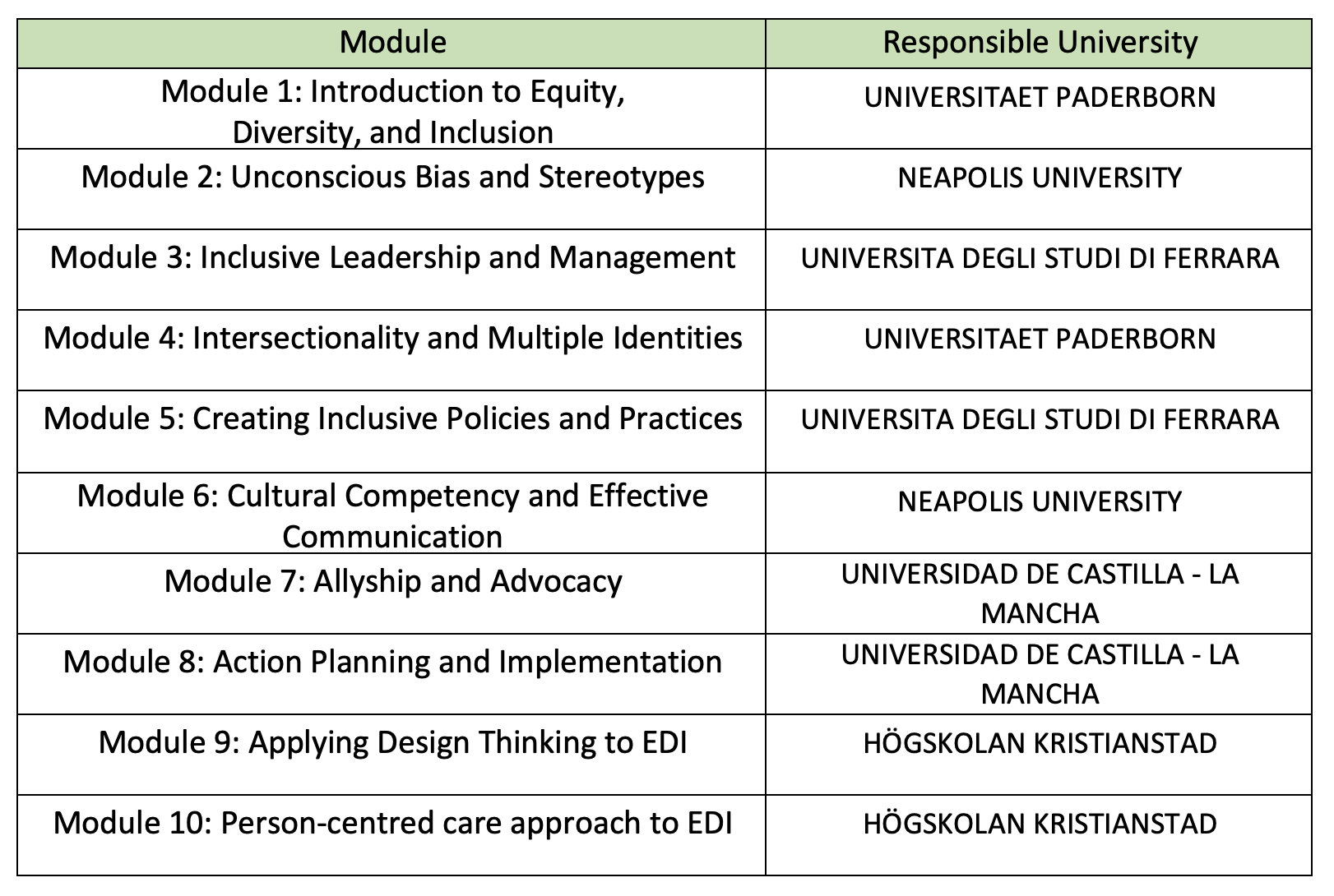
The IDEATE course plans cover all ten developed courses and include detailed information on course objectives, required materials, learning outcomes, lecture structures, recommended literature, exercises, and assessment methods.

The IDEATE courses
A total of ten IDEATE courses have been developed as part of the project, each designed to provide a comprehensive and engaging learning experience. Every course includes detailed lecture scripts, individual and group assignments, recommended readings, and interactive exercises to encourage active participation and reflection. In addition, each course features structured examinations and assessment methods to ensure that learning outcomes are achieved and that participants can apply their new knowledge and skills in practice.
Together, these courses form a cohesive curriculum that supports both academic learning and professional development, aligning with the project’s overarching goals of promoting innovation, inclusion, and excellence in education and training.